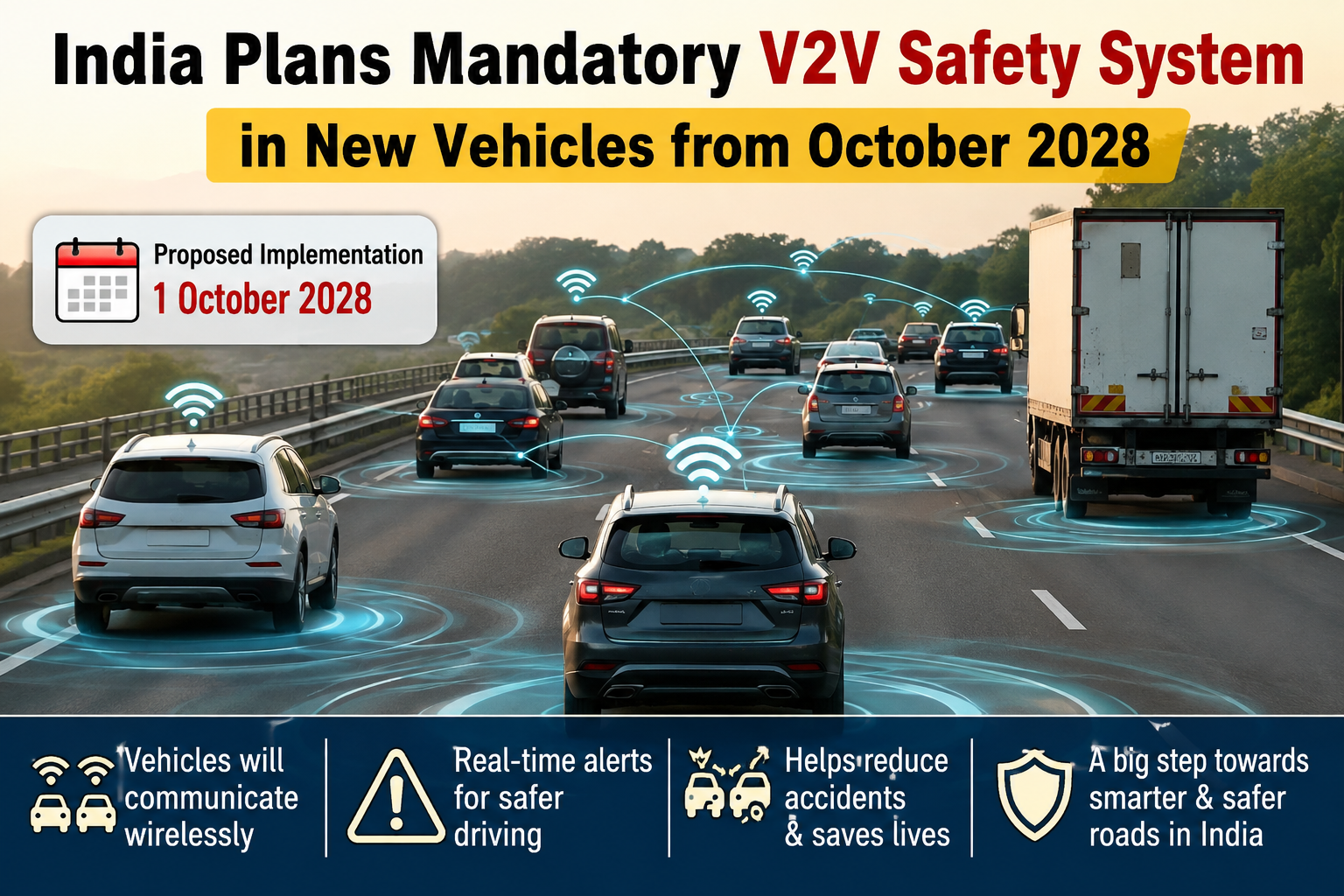
India Plans Mandatory V2V Safety System in New Vehicles from October 2028: What Every Driver Should Know
The Government of India has proposed making Vehicle-to-Vehicle (V2V) communication systems mandatory in all new vehicles from October 1, 2028. Learn how V2V technology works, its benefits, which vehicles will be affected, and what this proposal means for drivers and road safety in India.
India Plans Mandatory V2V Safety System in New Vehicles from October 2028: What Every Driver Should Know
The Ministry of Road Transport and Highways (MoRTH) has released a draft proposal that could transform road safety across India. According to the proposal, all newly manufactured vehicles may be required to feature Vehicle-to-Vehicle (V2V) communication technology from October 1, 2028.
It is important to note that this is currently a draft notification and has not yet become law. The government has invited feedback from vehicle manufacturers and other stakeholders before issuing the final notification.
What is Vehicle-to-Vehicle (V2V) Technology?
Vehicle-to-Vehicle (V2V) communication is an advanced safety technology that enables nearby vehicles to exchange information wirelessly in real time. Unlike traditional safety systems that rely only on cameras and sensors, V2V allows vehicles to "talk" to each other, helping drivers receive warnings about potential dangers before they become visible.
Vehicles equipped with V2V technology can automatically share:
- Vehicle speed
- Current GPS location
- Direction of travel
- Emergency braking status
- Acceleration and deceleration
- Road hazard alerts
How Does V2V Work?
Imagine you are driving on a highway and a truck suddenly applies emergency brakes around a blind curve. Since the truck is not yet visible, the chances of a collision increase.
With V2V technology, the truck immediately broadcasts an emergency braking alert to nearby vehicles. Your vehicle receives the warning within milliseconds, giving you enough time to slow down or stop safely.
This real-time communication can help prevent accidents even when drivers cannot see the danger ahead.
Vehicles Covered Under the Proposal
If approved, the proposed mandate will apply to all newly manufactured vehicles in the following categories:
- Two-wheelers
- Three-wheelers
- Cars and SUVs
- Vans
- Buses
- Trucks
- Commercial vehicles
The current proposal does not require existing vehicles already on the road to install V2V technology.
Major Benefits of V2V Technology
- Reduces the risk of road accidents
- Provides early collision warnings
- Improves highway safety
- Warns drivers about vehicles hidden around curves or intersections
- Helps manage traffic more efficiently
- Supports future connected and smart vehicles
- Improves overall road safety for drivers and passengers
Situations Where V2V Can Help
V2V technology can automatically warn drivers about:
- Emergency braking ahead
- Stopped vehicles on the road
- Wrong-way driving
- Blind intersection traffic
- Lane-change collision risks
- Sharp curves
- Traffic congestion ahead
- Slippery road conditions
- Accidents ahead
V2V vs ADAS: What's the Difference?
Many modern vehicles already feature Advanced Driver Assistance Systems (ADAS), but V2V works differently.
ADAS relies on cameras, radar and sensors installed on the vehicle to detect nearby objects. V2V, however, enables vehicles to communicate directly with each other, allowing drivers to receive alerts about hazards that cameras or sensors may not yet detect.
Both technologies complement each other and can significantly improve road safety when used together.
Will New Vehicles Become More Expensive?
Since manufacturers will need to install additional communication hardware and software, new vehicle prices could increase slightly. However, industry experts believe the long-term reduction in accidents and improved safety will outweigh the additional cost.
Is the Rule Final?
No. The proposal is currently in the draft stage. The government will review feedback from industry stakeholders before issuing the final notification. If approved, the mandate is expected to come into effect from October 1, 2028.
What This Means for Indian Drivers
If implemented, V2V technology will become one of the most significant vehicle safety upgrades introduced in India. Drivers purchasing new vehicles after the implementation date could benefit from real-time safety alerts that help prevent accidents and improve awareness on the road.
The proposal also marks an important step toward connected mobility and smarter transportation systems in India.
Conclusion
The proposed V2V safety mandate demonstrates India's commitment to improving road safety through advanced technology. Although the regulation has not yet been finalized, it has the potential to reduce accidents, save lives and make Indian roads safer for everyone.
Vahan Chalak will continue to bring you the latest updates on automobile regulations, road safety initiatives and transport industry news as more information becomes available.