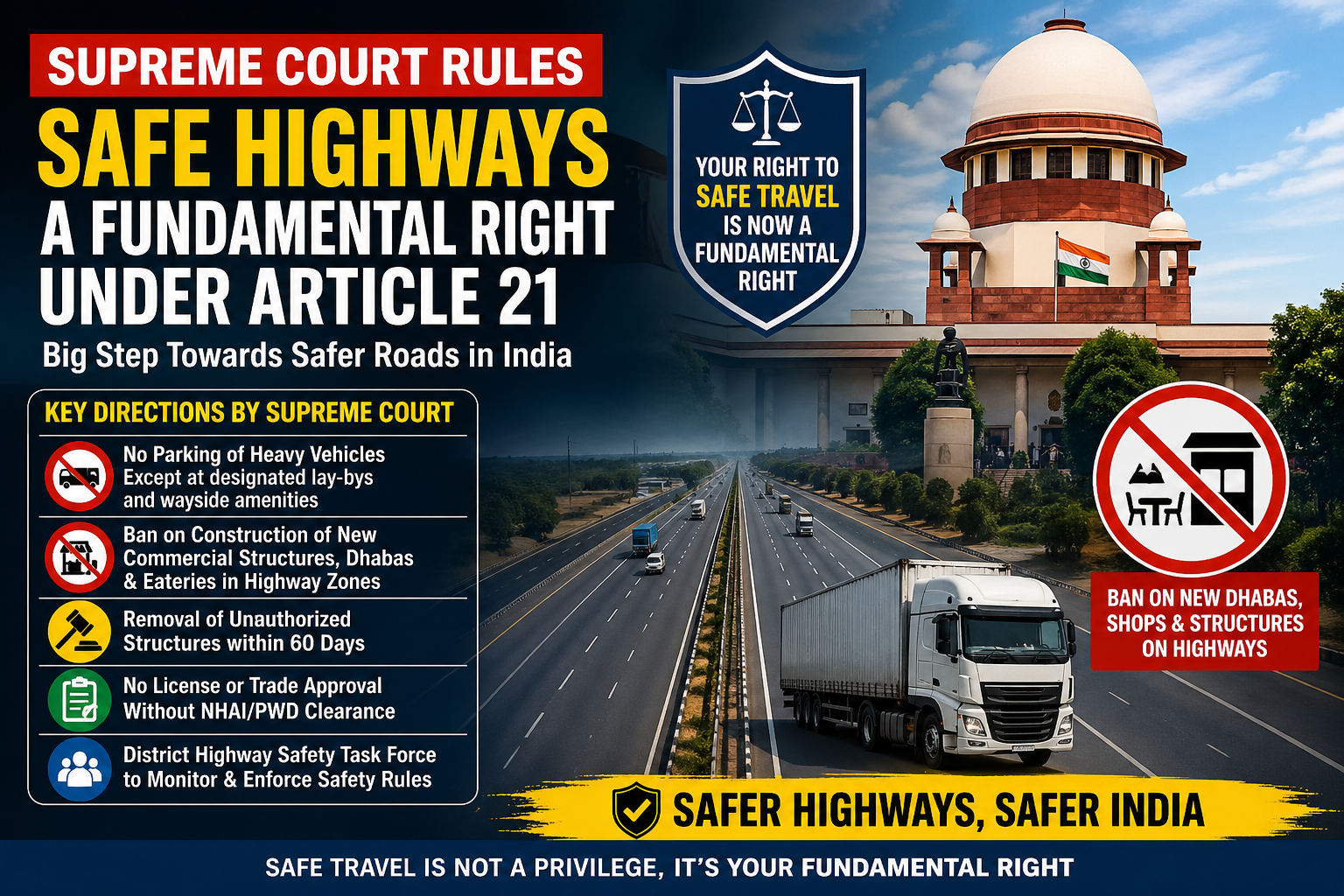
Supreme Court Declares Safe Highways a Fundamental Right Under Article 21: What It Means for Drivers and Commuters
India’s road safety landscape is undergoing a significant transformation after a landmark ruling by the Supreme Court of India. The Court has officially recognized that safe travel on highways is not just a necessity—but a fundamental right under Article 21 of the Constitution, which guarantees the right to life. This decision carries major implications for drivers, transport businesses, and daily commuters across the country, especially those frequently traveling on National Highways.
Understanding Article 21 and Its Expansion
Article 21 of the Indian Constitution ensures the right to life and personal liberty. Over the years, its interpretation has expanded beyond mere survival to include the right to live with dignity and safety.
With this ruling, the Court clarified that:
- The State has a positive obligation to ensure safe road infrastructure
- Preventable road accidents are not just unfortunate events—they reflect systemic failure
- Citizens have a legal right to safe highways, not just a moral expectation
This is a major shift from reactive governance to accountability-driven road safety policy.
Alarming Reality: National Highways and Fatalities
Despite being the backbone of long-distance travel, National Highways present a serious risk.
- National Highways make up only 2% of India’s total road network
- Yet, they account for nearly 30% of total road accident deaths
This imbalance highlights severe issues such as:
- Poor enforcement of safety rules
- Unauthorized roadside activities
- Improper parking of heavy vehicles
- Lack of structured rest stops
For drivers working long hours—like those in services such as Vahan Chalak—this risk becomes even more critical.
Immediate Ban on Roadside Commercial Structures
One of the most impactful directives is the complete ban on new commercial constructions within highway right-of-way areas.
This includes:
- Dhabas
- Roadside eateries
- Shops
- Unauthorized stalls
Why this matters:
- These structures often cause sudden vehicle stops
- They create traffic congestion and blind spots
- Increase chances of rear-end collisions
Existing unauthorized structures must now be removed within 60 days, under strict supervision of district authorities.
Strict Parking Rules for Heavy Vehicles
The Court has imposed strict restrictions on parking:
- No heavy or commercial vehicle can stop or park on highways
- Parking on carriageways or paved shoulders is strictly prohibited
- Vehicles can only stop at:
- Designated lay-bys
- Official wayside amenities
This rule directly targets one of the biggest causes of highway accidents:
stationary trucks causing high-speed collisions, especially at night.
Enforcement Responsibility: District-Level Action
To ensure implementation, the Court has empowered local administration:
- District Magistrates must:
- Identify illegal structures
- Remove them within 60 days
- No new business licenses will be granted without approval from:
- National Highways Authority of India (NHAI)
- Public Works Department (PWD)
This ensures centralized control with localized enforcement, reducing loopholes.
Formation of District Highway Safety Task Force
A major institutional reform introduced is the creation of a:
District Highway Safety Task Force
This body will:
- Monitor highway safety compliance
- Coordinate between departments
- Ensure enforcement of rules
- Identify accident-prone zones
- Take preventive action
This structured mechanism aims to eliminate the fragmented approach to road safety seen in the past.
What This Means for Drivers (Especially Professional Drivers)
For driver service providers like Vahan Chalak, this ruling brings both responsibility and opportunity.
Key Changes Drivers Must Follow:
- Avoid stopping on highways unless at designated zones
- Do not park vehicles on shoulders or carriageways
- Use only approved rest areas
- Be aware of newly enforced restrictions
Benefits for Drivers:
- Safer driving conditions
- Reduced accident risks
- Better organized highway infrastructure
- Improved working environment
Impact on Travel and Transport Industry
This ruling will reshape the entire highway ecosystem:
Positive Outcomes:
- Reduced fatal accidents
- Better traffic flow
- Cleaner and safer highways
- Organized roadside infrastructure
Challenges:
- Removal of informal roadside businesses
- Need for more government-approved rest areas
- Transition period for enforcement
Why This Matters for Vahan Chalak Users
If you hire drivers through Vahan Chalak, this ruling ensures:
- Safer journeys across highways
- More disciplined driving practices
- Reduced risk during long-distance travel
- Better compliance with national safety standards
Your safety is now not just a service feature—it is a constitutionally protected right.
Conclusion
The Supreme Court’s decision marks a turning point in India’s road safety framework. By bringing highway safety under Article 21, it elevates the issue from policy discussion to fundamental rights enforcement.
For drivers, transport businesses, and commuters, this is a clear message:
Safe travel is not optional—it is a legal guarantee.
As enforcement begins across districts, adapting to these changes will be crucial. Platforms like Vahan Chalak are well-positioned to align with these reforms and provide safe, compliant, and reliable driver services across India.
Frequently Asked Questions (FAQs)
Is highway safety now a fundamental right in India?
Yes, the Supreme Court has declared safe highway travel as part of Article 21, making it a fundamental right.
Are dhabas banned on highways?
New dhabas and commercial structures are banned within highway zones. Existing illegal structures must be removed.
Can trucks park on highways?
No, heavy vehicles cannot park on highways or shoulders. Only designated areas are allowed.
Who will enforce these rules?
District Magistrates and a new Highway Safety Task Force will ensure strict implementation.
How does this affect drivers?
Drivers must follow strict parking and safety rules, leading to safer driving conditions and fewer accidents.